
The Value of a Short Commute

Time is one of the few things that genuinely can’t be recovered. And while it rarely appears on a floor plan or in an amenity list, proximity, how close you are to where you need to go and how reliably you can get there, shapes daily life in ways that are hard to overstate.
Across Optima’s communities in Chicago and Scottsdale, the relationship between location and how people live looks different depending on the city, the neighborhood, and what a given resident actually needs. But in each case, the decision to site a building where it sits was made with that relationship in mind.
Downtown Chicago: On Foot, by Bus, or Along the Lake
In Streeterville, a large portion of daily life unfolds within walking distance. Optima Signature sits a block from Michigan Avenue, with the lakefront path, the Riverwalk, the Loop, and dozens of restaurants and shops reachable without getting into a car or waiting for a train. CTA bus service along Michigan Avenue offers multiple routes running throughout the day, and the Grand Avenue Red Line station is about a seven-minute walk from the building.
For residents who work in the Loop or along the Magnificent Mile, the commute can effectively be zero in the way most people think of commutes. Dinner reservations, coffee, weekend errands: most of it happens within the same walkable radius. Streeterville is built for that kind of proximity, with daily life folded into a few square blocks.

Lakeview: Transit-Oriented, Neighborhood-Rooted
Optima Lakeview sits in one of Chicago’s most transit-rich residential neighborhoods. The Red Line at Addison is within walking distance, and Belmont station, where the Red, Brown, and Purple lines converge, is also accessible on foot. From Addison or Belmont, a Red Line ride south to the Loop typically runs 15 to 25 minutes depending on time of day.
What’s notable about Lakeview as a location is what it enables beyond the commute itself. Multiple CTA bus routes fill in the east-west connections and off-peak gaps that rail doesn’t cover. The Broadway corridor offers grocery stores, pharmacies, and a dense concentration of restaurants, which means that even on days when residents aren’t commuting, the neighborhood is navigable without a car. The community’s ground-floor retail extends that walkable utility directly into the building.

Wilmette: The Metra Advantage
Optima Verdana in downtown Wilmette occupies a position that most suburban developments don’t come close to achieving, it sits directly across Green Bay Road from the Wilmette Metra commuter rail station. For residents who commute into downtown Chicago, this proximity makes a meaningful difference. The Union Pacific North line runs from Wilmette to Chicago’s Ogilvie Transportation Center in the Loop, connecting the two with consistent timing across the day.
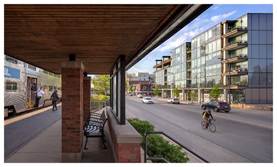
The location also puts residents within walking distance of Wilmette’s Village Center, with shops, cafes, and services immediately accessible on foot. More than 60 acres of lakefront, including beaches and a sailing harbor, are within walking distance as well. What Verdana offers, that a car-dependent North Shore address doesn’t, is the option to leave the car behind without losing the ease of getting anywhere you need to go.
Scottsdale: A Different Definition of Proximity
In Scottsdale, proximity gets measured differently. There’s no rail system shaping the conversation, so what matters is what’s reachable by car in a few minutes, and what’s reachable on foot without one.
Optima Sonoran Village sits in Old Town Scottsdale, across from Scottsdale Fashion Square, with restaurants, galleries, and nightlife within walking distance. Camelback Mountain’s hiking and biking trails are close by as well.
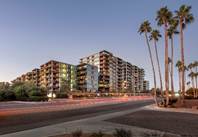
Optima Kierland sits on Kierland Boulevard in North Scottsdale, steps from both Kierland Commons and Scottsdale Quarter. Restaurants, coffee, shopping, and entertainment are reachable without a car for residents who want that option. For longer trips across the Valley, the Loop 101 offers direct access to Scottsdale, Tempe, and Phoenix. Phoenix Sky Harbor is approximately 18 miles away. The community’s position means residents with demanding schedules can move efficiently in either direction, into the urban core or out toward the desert.
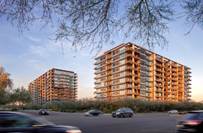
Optima McDowell Mountain sits right at Scottsdale Road and Loop 101, so residents are already at the freeway rather than driving to it. That gives direct access to the Valley’s freeway network in either direction, alongside a walking and biking radius close to home. Restaurants, retail, and everyday grocery stops are reachable on foot, and the nearby mountain views and trail access add a kind of value that doesn’t show up in a walk score: open space and a sense of retreat, right alongside the convenience.
What Location Actually Gives You
In practical terms, a well-chosen location gives residents time back, not necessarily in large blocks, but in the accumulated minutes of a week where a commute is predictable, an errand is walkable, and getting somewhere doesn’t require planning your whole day around it.
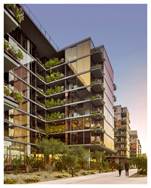
Optima’s communities differ in what their locations offer, because the neighborhoods themselves differ. What stays consistent is the deliberate decision of the siting: each building’s location was chosen for what surrounds it, and that surrounding context is part of what makes living there work.
Explore Optima’s communities across Chicago and Scottsdale to see how location shapes daily life at each one.


Latest Articles

What Living Across the Optima Portfolio Has in Common

Evenings on the Sky Deck
